

Passing the Hot-Potato
- Posted by Mary's Advocates
- On March 17, 2026
- 0 Comments
Asking the Canon Law Society of America to be Corrected
I have a complaint against the Canon Law Society of America, and I asked the competent bishop for a judgement (i.e., Cardinal McElroy in Washington, D.C.).

Cdl. McElroy
He has decided to issue no judgment, and I question whether his reasons for refusal are well-founded, so we are making hierarchical recourse. My guess is that this complaint is going to end up getting passed around, like a hot potato, for months. In Pope Leo XIV’s 2026 address to the tribunal judges, he taught “The faithful and the entire ecclesial community have a right to the proper and timely exercise of procedural functions, because it is a journey that affects consciences and lives.” I pray that somebody at the Vatican will enforce proper procedure. (see below for “The Issue”)
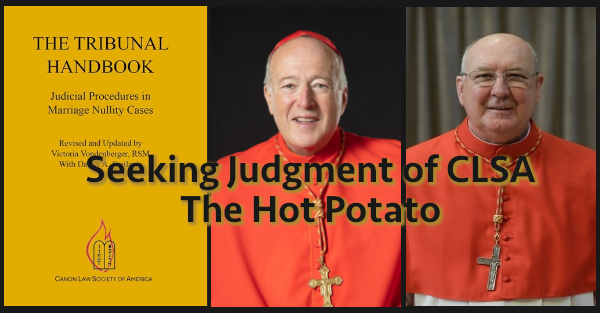
We support spouses working to defend their marriage against accusations of invalidity (commonly called an annulment). Even though tribunals are supposed to follow the same law worldwide, some dioceses disregard the law, making participation difficult for defendants. The problematic procedures are taught in the Canon Law Society of America’s 2024 publication, “The Tribunal Handbook, Judicial Procedures in Marriage Nullity Cases.” Moreover, the Handbook is supported by a judge at the Roman Rota, Msgr. David Jaeger, O.F.M., who wrote the preface and provided some content about procedures.
Publisher’s Bishop
On January 16, I wrote the archbishop in whose jurisdiction the Canon Law Society is incorporated (i.e., Cdl. McElroy, in D.C.). However, the Archdiocese will not issue any decision answering our petition, so we now can make recourse to a dicastery in Rome. In the Archdiocese’s rejection letter, it stated, “If you still wish to submit the matter to the Apostolic Signatura, you can address your correspondence to them at this address” (letter dated March 5).
I find odd that the Archdiocese of D.C. told me to write to the Signatura. There is a fifteen-day deadline to make recourse in an administrative case, and if I only wrote to the Signatura, I would miss the deadline. I must write to a dicastery, not the Signatura. The Signatura does not have competence to resolve an administrative controversy between me and an archbishop. It would have competence to judge a recourse only after I was aggrieved by a dicastery:
Praedicate Evangelium Art. 197 §1 – The Apostolic Signatura, as the administrative tribunal for the Roman Curia, adjudicates recourses against individual administrative acts, whether issued by the Dicasteries or the Secretariat of State or else approved by them, whenever it is contended that the act being impugned violated some law, either in the decision-making process or in the procedure employed.

Cdl. Farrell
So, our next step is to make recourse to whichever dicastery we think has competence in the matter. I’m going to, first, try the Dicastery for the Laity, the Family and Life. While I’m at it, I’ll send a copy to the Signatura and ask it for a determination of competence about whether another Dicastery should direct the investigation of our complaint. I’m also going to send to the Signatura a handful of letters from parties who have collaborated with Mary’s Advocates and these letter give proof that the Canon Law Society of America is wrong.
Author’s Superior
Our Code of Canon Law protects the faithful from being taught nonsense, and the competent authority over a religious priest’s writings is his major Superior. Because Msgr. Jaeger is a member of the Order of Friars Minor (a Franciscan), I sent a petition to his major superior in Israel, which was delivered today (Mar. 17). I also sent a petition to the Dean of the Roman Rota since Jaeger is a judge there. Msgr. Jaeger gave the Canon Law Society of America excerpts from Rota decisions that the Canon Law Society of America uses to support their recommendation for a practice that I find to be illegal.
The Issue
You can see our 19 January 2026 petition to the Bishop of the Archdiocese of Washington, DC. See Our Letter.
I find the Canon Law Society of America’s Handbook gives scandal to the faithful because it broadens the psychological grounds for annulment to include the failure of one spouse to know the other well enough (can. 1095, 2°, grave lack of discretion of judgment).
The Handbook leads readers to conclude that the civil divorce courts are the proper authority to decide spouses’ obligations toward each other and their children. However, the Church has exclusive competence over cases of separation of spouses. Civil divorce is just a separation of spouses in the state government’s system.
The Handbook teaches petitioners that they can start an annulment case by just answering a long questionnaire about their upbringing, courtship, engagement, and married life. Consequently, tribunal personnel, thereafter, secretly accuse petitioners of having a severe form of psychopathology, even though, if the petitioner knew that was what was going on, the petitioner would object.
Many petitioners and respondents are kept in the dark because the tribunals make it difficult for parties to see the reasons for the annulment. The Handbook teaches that a tribunal does not need to send an interested party his/her own copy of the final sentence but only let the party read it at the tribunal office. Most petitioners likely only want the annulment and aren’t going to spend the time going to a tribunal office to read the sentence. Respondents wanting to uphold the validity of their marriage are going to have a very difficult time writing their reasons for appeal if they don’t have their own copy of the sentence.


0 Comments