

DDF Dodging Responsibility to Uphold Doctrine of the Faith
- Posted by Mary's Advocates
- On April 17, 2026
- 1 Comments
The Dicastery for the Doctrine of the Faith seems to be dodging their responsibility to uphold the doctrine of the faith. Of issue is whether this evidently controversial statement is correct or contrary to canon law and undermining faith and morals:
Prior to a Catholic petitioning a USA civil court for divorce or separation, the person needs permission of the bishop. One is not to decide on his own whether filing for civil divorce or separation can be tolerated in his situation, even though he may have consulted with priests, counselors, friends, or family members.
Rather than issuing decrees answering lawful canon law recourses submitted to the Dicastery for the Doctrine of the Faith, it is, apparently, telling each person’s bishop that “the matter before them is closed and they will not respond to further requests.”
Our readers may remember that the Cardinal who was reportedly attending a homosexual orgy in a Vatican apartment had issued a document that undermined marriage (2016 Two Wrongs Don’t Make a Right: Is the Church Handing Its Authority to No-Fault Divorce Courts?). Cardinal Coccopalmerio, who used to oversee the Dicastery for interpreting canon law, turned canon law upside down.
Mary’s Advocates publicizes how the Church has exclusive competence over cases of marriage separation. The means to implement this competence is specified in canon law. One is not supposed to act as his own judge deciding that, in his situation, it is tolerable to file in the civil (state) courts for divorce or separation. Only the bishop has competence to make this judgment. Many dioceses ignore this protection and simply teach that canon law is only applicable to annulments, not to separation. These dioceses teach that the state governments are the proper authority to decide all things related to separation or divorce.
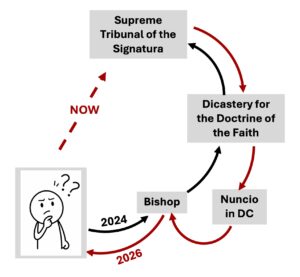
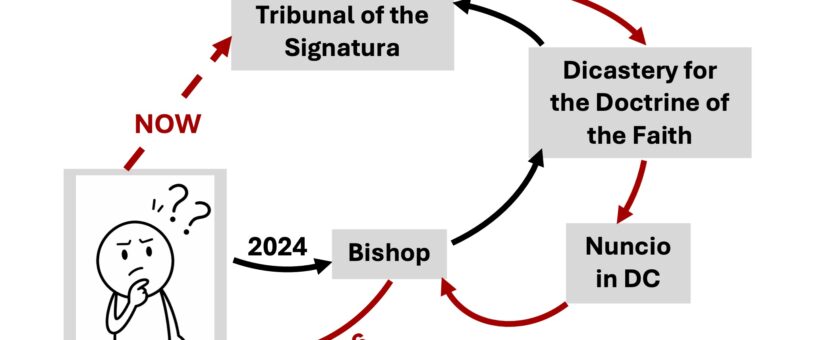
In an effort to get clear teaching, several persons undertook an endeavor in the summer of 2024. Each person asked his own bishop for permission to publish a leaflet with the evidently controversial statement shown above. The bishop should either give permission to publish the leaflet or give a reason for denying permission.
Each bishop either remained silent, denied permission to publish the statement, or had an officer in his chancery deny permission. So, each person appealed to Rome and eventually to the Supreme Tribunal of the Signatura. There are two levels of authority in Rome for these kinds of administrative petitions and recourses: 1) a dicastery; and 2) the Supreme Tribunal of the Signatura. Some of the individuals received letters from the Signatura saying the appropriate dicastery to judge the controversy is the Dicastery of the Doctrine of the Faith.
When a dicastery is silent after receiving a recourse, there is nothing a member of the faithful can do to force it to issue a judgment. However, the Signatura does have competence to instruct a dicastery to stop ignoring parties making recourse and issue a decision. I hope that happened and I wonder if Pope Leo XIV’s promulgation of the General Regulations of the Roman Curia (Italian) in November 2025 helped us. Applicable regulations include the following (unofficial English translation):
Art. 30 §2. Curial institutions cannot issue general laws and decrees, as per canon 29 of the Code of Canon Law, nor derogate from the provisions of the law established by the Roman Pontiff without his specific approval. However, they may grant dispensations in individual cases, in accordance with the law.
Art. 42 §2. The examination of appeals must be concluded within the time limits prescribed by can. 57 of the Code of Canon Law and by can. 1518 of the Code of Canons of the Eastern Churches; if the appeal requires a more thorough examination, the appellant must be informed of the extension and the reasons for it.
Within the last several weeks, some of the persons received letters either from their bishop, chancellor, or vicar general. Each letter was similar, saying that the Dicastery of the Doctrine of the Faith instructed the US Papal Nuncio to instruct the bishop that the Dicastery says the matter is closed. Additionally, the Nuncio says that it was instructed to forward no more letters to the Dicastery on behalf of the person making recourse. This is weird because canon law itself requires that an aggrieved appellant must ask a Dicastery to change its mind prior to appealing to the Signatura. It is also unusual because the US Papal Nuncio regularly forwards appeals to Rome Tribunals and Dicasteries for US residents. When someone brings a canon law action to a Rome Tribunal or Dicastery (via the Nuncio), the Nuncio sends a confirmation letter and assigns a record number, and this serves as proof of delivery. But in this matter, the Nuncio is telling the bishops that he is not allowed to forward anything more to the Dicastery.
Each of the persons, who received these unusual letters from diocesan personnel, wrote to both the US Nuncio and their local diocese asking for a copy of the so-called decree from the Dicastery of the Doctrine of the Faith, and no decree was provided. So, each individual now wrote the Signatura asking for an instruction to the Dicastery to issue a decision answering the recourse about the controversial statement.
Is anyone surprised that Cardinal Víctor Manuel Fernández, Prefect of the Dicastery for the Doctrine of the Faith, would refuse to answer a clear question about whether there is nothing contrary to faith, morals, or canon law in our evidently controversial statement?


1 Comment