


Canon Law Challenge Against No-fault Separation
- Posted by Mary's Advocates
- On May 21, 2026
- 1 Comments
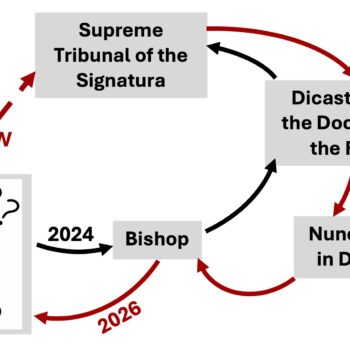
A Catholic husband, who we’ll call Jack Doe, has a pending appeal at the Dicastery for Divine Worship and Discipline of the Sacraments against his Archbishop’s marriage separation decree. He is objecting to the bishop issuing a spousal separation decree which contains no facts or specific legal reasons. The decree says it “simply recognizes that one or more grounds are present which meet the requirement to implement canon 1153.”
Further, Jack is aggrieved that the bishop decree permitted his wife (quote) “to approach the civil courts for the adjudication of their affairs, insofar as such civil judgment as may be rendered is not contrary to divine law (canon 1692, §2).”
Because of no-fault divorce, Jack is confident that the outcome in divorce court will be contrary to divine law. He’s heartbroken that his wife can now tell people, “See, the bishop gave me permission to divorce Jack.” Jack’s wife, who we’ll call Jane, takes pride in being a good Catholic and she works for a parish. Now, Jack is arguing—in the Catholic canon law forum—that his right of defense was denied by the bishop’s decree.
The decree was given after Jack petitioned for the Church for intervention when his wife filed for civil no-fault divorce (See petition available at Mary’s Advocates). If pastoral attempts to encourage Jane to reconcile failed, Jack’s petition asked for a “decree of abandonment (maliciosam desertionem).” After Jane thought that she had the bishop’s permission to divorce Jack, he filed recourse with the Dicastery for Divine Worship and Discipline of the Sacraments in March and asked the Dicastery to suspend the bishop’s permission for Jane to pursue civil divorce.
This is where the situation gets really convoluted. The Dicastery’s decree says the bishop did not give Jack’s wife permission to approach the civil courts (quote): “[T]he [bishop’s] decree does not confer permission but simply acknowledges that recourse to the civil forum may be necessary for such matters.” In Jack’s latest complaint submitted to the Dicastery, he elaborates on how permission from one’s bishop cannot be ambiguous:
Jack says he intends to bring his challenge to the highest court in the Catholic world, the Supreme Tribunal of the Apostolic Signatura. In his interim pleading to the Dicastery, Jack repeats that the bishop’s decree cannot go into effect because it gives no actual description of the reason for separation of spouses.


1 Comment